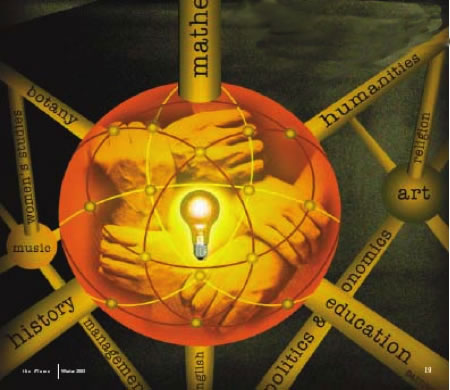
In the future, the database will include expert “RANKINGS” for the work and contributions of each expert. As the fields, features and competencies of global experts and categorical groups grow; a quality rubric of diverse contributions will be shared among volunteers to determine a possible ranking system.
As a computer scientist, researcher and Fellow at Harvard’s Berkman Klein Center for Internet & Societyand a Technology and Human Rights Fellow Carr Center for Human Rights Policy, I focus on the ethical implications of technology in the developing world, particularly in Sub-Saharan Africa, along with the creation of tools to make Artificial Intelligence more accessible and inclusive to underrepresented communities.
This is today’s edition of The Download, our weekday newsletter that provides a daily dose of what’s going on in the world of technology. Introducing: the Impossible issue We wanted our last print edition of 2026 to include a slate of stories that check in on impossible ideas. Why? Because it’s fun to dream about…
Every year, traffic crashes kill more than one million people, and they’re the leading cause of death for children and young adults. In the US, 100 people a day lose their lives this way, in many cases not on highways but on rural and local streets. “Traffic deaths are a leading cause of preventable death,…
The rise of the lithium-ion battery, which powers everything from the smallest personal electronics to gargantuan energy storage systems, has been nothing short of revolutionary. But as anyone who’s boarded a plane in the last decade could tell you, storing and pumping out energy by moving charged lithium ions through a liquid electrolyte soup has…
Scrubbing Earth of per- and polyfluoroalkyl substances—a.k.a. PFAS or forever chemicals—could eliminate a list of woes for people and planet. Used for decades in everything from nonstick pans to firefighting foams, PFAS have been linked to increased risks of fertility challenges, developmental delays, cancer, and reduced immune response. They are known for a strong bond…